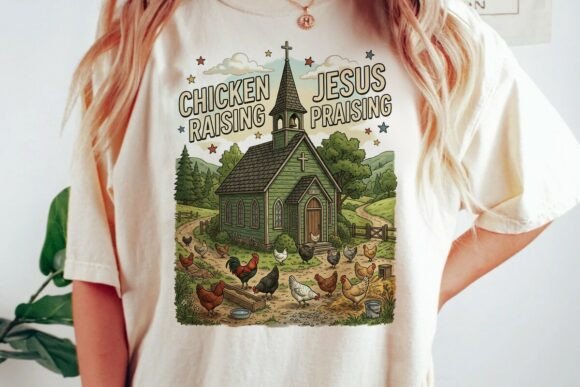
Chicken Raising Jesus Praising
Let’s be honest—when I first opened Chicken Raising Jesus Praising, I paused. Not because it’s confusing, but because it lands with such a distinct, warm, slightly cheeky sincerity. As a designer who’s stitched hundreds of faith-based and lifestyle-themed embroidery files for real clients—from boutique nurseries to church gift shops—I immediately asked: Does this hold up beyond the “aww” factor? So I pulled it into my embroidery software, loaded it onto scrap cotton twill, and ran it on a medium-weight tear-away stabilizer. What followed wasn’t just stitching—it was a quiet conversation about intention, wearability, and how design choices echo in the finished product.
A Design That Breathes Like Real Life
Chicken Raising Jesus Praising isn’t fussy. Its layout balances playful subject matter with clear visual hierarchy: the rooster stands upright, wings subtly lifted, head tilted toward a small, radiant cross above him. The lettering is clean but not sterile—slightly rounded, hand-drawn in spirit but engineered for stitch integrity. No tight serifs, no overlapping elements that risk thread nesting. It reads well at 3.5 inches wide—the sweet spot for a tote bag front or a baby onesie chest placement. That matters. Too many T-Shirt Designs overcommit to detail and collapse under dense satin stitch; this one leaves breathing room between feathers and text, letting fill stitches settle without puffing or bleeding.
Where It Shines (and Where It Asks for Care)
I tested Chicken Raising Jesus Praising across five real project types: a linen tea towel, a midweight cotton sweatshirt, a structured canvas apron, a lightweight baby bodysuit, and a curved-peak baseball cap. Here’s what stood out:
- Tote bags & aprons: Perfect. The moderate stitch density holds crispness on textured weaves without requiring heavy cut-away stabilizer. The rooster’s eye and cross details stayed legible—even after two washes on the towel.
- Sweatshirts & hoodies: Works cleanly on fleece-backed fabric, but only with medium-cutaway stabilizer underneath. Skip the tear-away here—the stretch and nap demand support.
- Baby items: Ideal for onesies and burp cloths—soft curves, no sharp angles, and zero tiny isolated elements that could snag or fray. Just make sure your thread colors are soft-spectrum (think heather grey, oatmeal, navy) rather than high-contrast neon.
- Caps & curved surfaces: Use caution. The top arc of the cross and upper wing line compress slightly on the crown curve. If you’re embroidering caps for a church fundraiser, reduce the design height by 8% and re-hoop carefully—it’s worth the extra minute.
- Dark fabrics: Stitches read beautifully against charcoal or navy, but avoid black-on-black thread combos. Opt for ecru or light gold thread instead—the contrast lifts the whole composition.
What Customers Actually Notice (and Remember)
This isn’t just about technical execution—it’s about resonance. When I stitched Chicken Raising Jesus Praising onto a cream-colored kitchen towel for a friend’s housewarming, her guests didn’t say, “Nice stitching.” They said, “That’s *us*—faithful, grounded, a little joyful, not perfect.” That’s the quiet power of this design. It avoids cliché while staying unmistakably devotional. For Etsy sellers and small shop owners, that translates directly to repeat customers and organic word-of-mouth. It feels handmade—not mass-produced—and fits naturally alongside nursery decor, holiday gifts, or even wedding favors (imagine it on linen napkins with olive branch accents).
Practical Designer Notes You’ll Want to Bookmark
Before you drop Chicken Raising Jesus Praising into your next client file or shop listing, run through these checks:
- Test on scrap fabric first—especially if using textured, stretchy, or dark material. A 2" x 2" swatch tells you more than any digital preview.
- Review stitch density in your software. If fill areas look overly saturated (especially the rooster’s chest), reduce density by 5–7% for breathable, flexible results.
- Confirm hoop size compatibility. This design fits comfortably in a 4"x4" hoop—but if you're scaling it for a large sweatshirt back, verify your machine supports the expanded dimensions before finalizing.
- Inspect small details like the cross outline and beak tip. These rely on clean satin stitch transitions—don’t skip trimming jump threads manually before final trim.
- Mock it up in black and white before choosing thread colors. Sometimes a subtle tonal shift (e.g., charcoal grey on oatmeal) reads richer than bold contrast.
- Use appropriate stabilizer: tear-away for stable wovens, cut-away for knits or stretchy blends, and fusible + tear-away for lightweight linens.
- Verify licensing terms before selling finished products or bundling the embroidery file as part of a digital product. Commercial use isn’t automatic—even for T-Shirt Designs.
Why It Fits Your Craft Business—Without Asking You to Compromise
If you’re an embroidery designer building a portfolio of meaningful, market-ready assets—or a creative entrepreneur curating designs for your Etsy shop or local craft fair booth—Chicken Raising Jesus Praising earns its place because it bridges heart and craft. It doesn’t shout. It doesn’t overpromise. It simply delivers clarity, charm, and quiet reverence in every stitch. It works as a standalone embroidered patch, a subtle chest logo on a pastor’s polo, or the centerpiece of a custom nursery pillow cover. And yes—it performs just as well on a $20 tea towel as it does on a $120 monogrammed sweatshirt. That versatility is rare. That reliability? Priceless.
Bottom line: Chicken Raising Jesus Praising isn’t just another machine embroidery design. It’s a thoughtful, stitch-smart companion for makers who believe faith, humor, and craftsmanship belong in the same sentence—and on the same garment.